

Good Data Costs Less Than One Bad Bet
I built my first NBA betting model using data I copied manually from box scores into a spreadsheet. Fifteen games in, I had made three data-entry errors that silently corrupted my net-rating calculations. The model looked fine. The outputs were plausible. But the predictions were wrong because the inputs were wrong, and I did not discover the errors until I had already placed 40 bets based on them. The basketball betting market is valued at $8.7 billion and is projected to reach $18.4 billion by 2033 — and a meaningful chunk of that growth comes from bettors who would be profitable if their data pipelines were clean.
This article is a practical guide to the data sources available to NBA bettors, from free databases that cover 90% of what you need to paid feeds that cover the remaining 10%. The goal is not to spend as much as possible on data — it is to build a research stack that is reliable, current, and sufficient for the markets you target.
Free Sources: Basketball-Reference, NBA.com Stats, and APIs
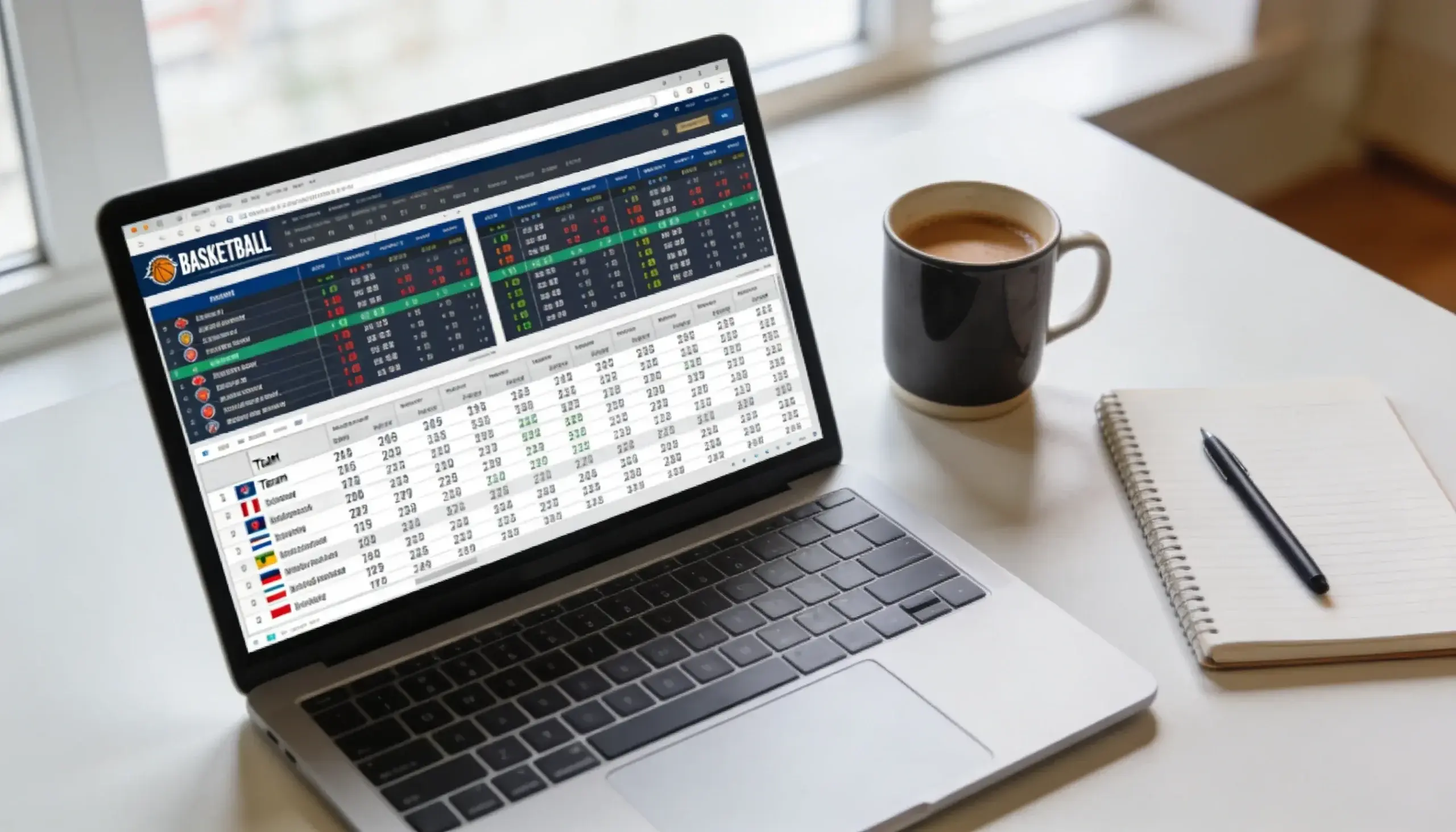
Basketball-Reference is the foundational resource for every NBA bettor I know. It provides team and player statistics dating back to the 1946-47 season, with advanced metrics including offensive and defensive rating, pace, eFG%, true shooting percentage, net rating, and usage rate. The data updates daily during the season, typically within a few hours of game completion. For historical analysis and model backtesting, it is unmatched among free sources.
NBA.com’s stats portal offers similar core data with additional filtering capabilities. You can segment by game type (home, away, back-to-back), by opponent, by date range, and by clutch situation. The filtering is especially useful for prop modelling: you can pull a player’s points per game against top-10 defences, or a team’s pace in the first quarter of away games. The interface is less intuitive than Basketball-Reference, but the granularity of the filters justifies the learning curve.
The NBA’s partnership with tracking data providers has opened up real-time player-tracking data that enables micro-level analysis — player speed, distance covered, shot-contest frequency, and touch-based metrics. This data, available through the NBA’s official stats API, represents the same foundation that bookmakers use to price micro-bets like next scorer and two-minute scoring windows. Accessing the API requires basic programming ability (Python is the standard), but several open-source libraries wrap the API in user-friendly functions. For bettors building automated models, the API is the most efficient data pipeline available at zero cost.
One underrated free source is the official NBA injury report, published daily by 5pm ET during the season. The injury report is the single most market-moving piece of information in NBA betting, and it is available to everyone simultaneously. Cross-referencing the injury report with your model’s player-impact calculations gives you a pre-built workflow for identifying value in the 30-60 minutes between the report’s release and tip-off.
Paid Data: Synergy, Second Spectrum, and Cleaning the Glass
Paid data services fill gaps that free sources cannot. The most valuable gap is play-type data — how teams score by action type (pick-and-roll, isolation, transition, post-up, spot-up). Synergy Sports provides this data at both the team and player level, allowing you to project how a specific matchup will play out by comparing each team’s offensive action distribution against the opponent’s defensive action efficiency.
Second Spectrum provides the optical tracking data that underlies the NBA’s official player-tracking stats. The raw Second Spectrum data is expensive and primarily available to NBA teams and media partners, but derivative products — shot quality models, expected possession value calculations — are accessible through third-party platforms at lower cost. These derivative metrics add a layer of context that raw box-score data misses: not just how many shots a player took, but how difficult those shots were.
Cleaning the Glass is the paid service I recommend most frequently to fellow bettors. It filters out garbage time and end-of-quarter heaves from all its calculations, producing adjusted metrics that are more predictive than raw numbers. The difference matters: a team’s offensive rating including garbage time can differ by 2-3 points per 100 possessions from its garbage-time-filtered rating, and that difference translates directly into spread and totals accuracy. The subscription costs roughly the same as one or two standard bets — a trivial investment for a data source that improves every projection you make.
Historical Odds Data and Closing Line Archives
Your model produces a number. The bookmaker produces a number. The edge lives in the gap between them. But to measure that gap — and to track your CLV over time — you need historical odds data. Closing lines, opening lines, and line-movement timelines are the raw material of performance measurement.
Several free sources archive NBA closing lines, typically from one or two reference bookmakers. These archives are sufficient for basic CLV tracking: record the line at which you bet, record the closing line from the archive, and calculate the difference. Over hundreds of bets, your average CLV tells you whether your process is sound.
For more granular analysis — line-movement charts, odds from multiple bookmakers, historical overround comparisons — paid odds databases offer deeper coverage. The investment is justified if you are betting into multiple bookmakers and need to track which operators consistently offer the best NBA prices. Your betting model is only as good as the data feeding it, and odds data is the feedback loop that tells you whether the model’s outputs are capturing real edge or theoretical value that disappears by closing.
The research stack I use daily consists of three layers: Basketball-Reference for team and player stats (free), Cleaning the Glass for garbage-time-adjusted metrics (paid, low cost), and a closing-line archive for CLV tracking (free for basic needs, paid for multi-bookmaker depth). That stack costs less than £15 per month and provides every data point I need for spread, total, and prop modelling. The expensive data services — Synergy, Second Spectrum — are valuable for specific use cases but not necessary for the core betting workflow. Start lean, add layers only when you have identified a specific analytical gap that the additional data would fill.
